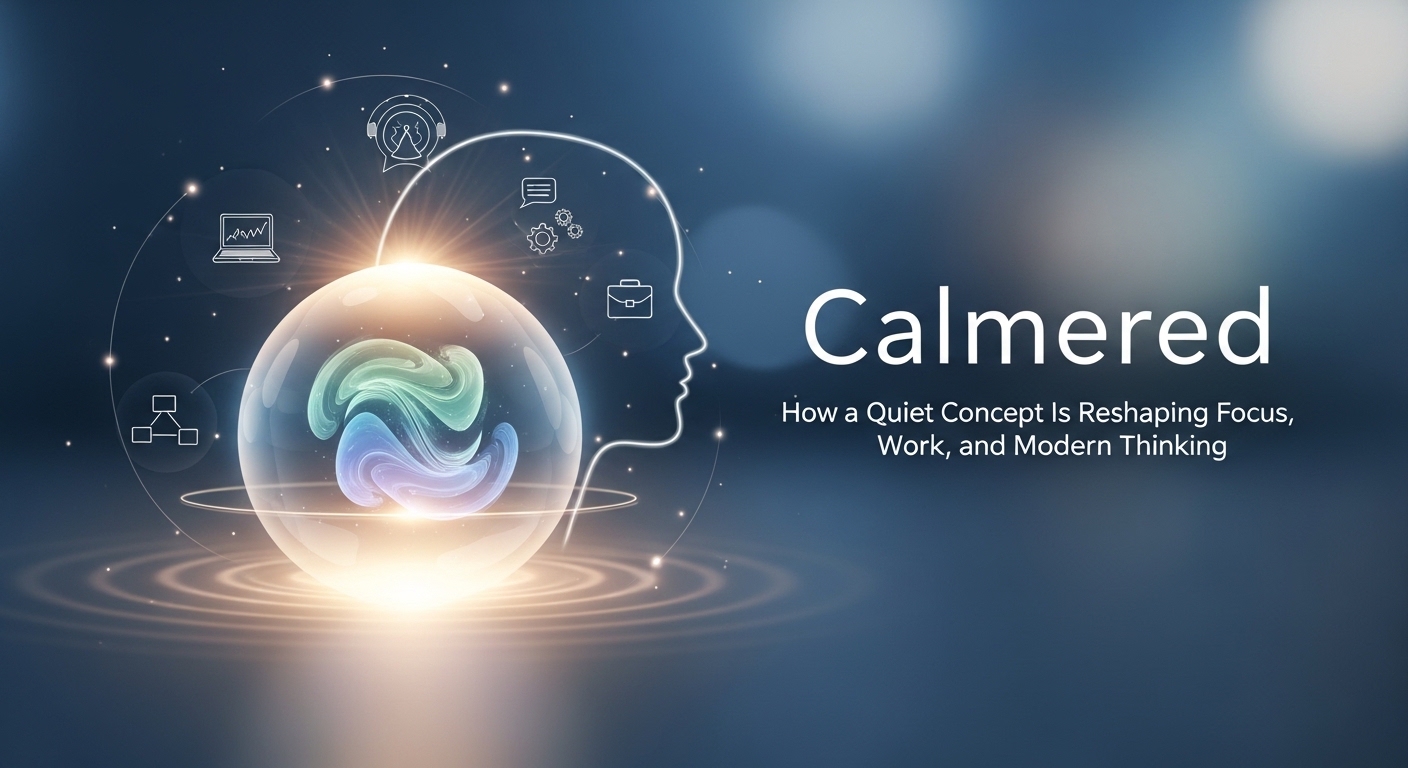
In the middle of a noisy café, a founder closes their laptop and exhales. Notifications are silenced, the to-do list is untouched, and for a rare moment, clarity appears. This scene plays out every day across co-working spaces, home offices, and startup floors worldwide. The modern professional isn’t lacking tools or ambition; they are overwhelmed by constant mental friction. Out of this reality emerges calmered—a concept not built on speed or hustle, but on intentional calm paired with sharp execution.
Calmered is not a productivity hack, a wellness trend, or a vague motivational idea. It represents a shift in how entrepreneurs, tech readers, and founders approach decision-making, focus, and sustainable performance. In a world addicted to urgency, calmered argues that composure is not the opposite of ambition—it is its foundation.
Understanding the Core Idea Behind Calmered
At its heart, calmered blends two forces that are often treated as opposites: calmness and readiness. Calmness brings emotional regulation, reduced cognitive noise, and perspective. Readiness ensures responsiveness, competence, and momentum. Calmered exists where these forces overlap, allowing individuals to operate without panic while staying fully engaged with their goals.
Unlike mindfulness approaches that emphasize detachment, calmered stays grounded in action. It acknowledges deadlines, pressure, and competition but refuses to let them dictate internal chaos. This makes the concept especially relevant for founders who must think clearly while navigating uncertainty, risk, and rapid change.
Calmered is not about slowing down indiscriminately. It is about removing unnecessary mental resistance so energy flows toward meaningful work rather than constant reaction.
Why Modern Work Culture Is Moving Toward Calmered
The traditional narrative of success glorifies exhaustion. Long hours, constant availability, and relentless urgency have become status symbols in professional circles. However, data, experience, and burnout stories suggest this model is breaking down. High performers are realizing that chronic stress degrades judgment, creativity, and leadership quality.
Calmered aligns with this realization. It reframes composure as a competitive advantage rather than a luxury. Professionals operating in a calmered state make fewer impulsive decisions, communicate with clarity, and sustain output over longer periods without emotional depletion.
Remote work, asynchronous communication, and global collaboration have further accelerated this shift. When teams span time zones and cultures, reactive intensity becomes inefficient. Calmered offers a framework for measured responses, intentional pacing, and trust-based execution.
Calmered as a Mental Operating System
One way to understand calmered is to view it as a mental operating system rather than a single habit. It influences how information is processed, how priorities are set, and how pressure is interpreted. Instead of treating stress as an enemy, calmered treats it as data—useful but not dominant.
This operating system reduces internal friction. Thoughts become organized rather than scattered. Emotional responses become proportional rather than exaggerated. Over time, this creates a feedback loop where confidence grows because actions are thoughtful and outcomes are more consistent.
Importantly, calmered does not require a complete lifestyle overhaul. It integrates into existing workflows, enhancing how decisions are made rather than replacing tools or processes.
Practical Dimensions of Calmered in Daily Work
Calmered becomes visible through behavior. It shows up in meetings where listening outweighs interrupting. It appears in inbox management where urgency is evaluated rather than assumed. It exists in strategic planning sessions where space is left for reflection instead of filling every moment with action items.
Professionals practicing often report improved concentration, reduced decision fatigue, and stronger interpersonal dynamics. This is not coincidence. Calm mental states allow the brain to allocate resources more efficiently, supporting complex thinking and long-term planning.
The following table highlights how contrasts with more reactive work styles in practical terms:
| Aspect of Work | Reactive Mode | Calmered Approach |
|---|---|---|
| Decision-making | Fast but impulsive | Deliberate and informed |
| Communication | Emotion-driven | Clear and intentional |
| Time management | Urgency-led | Priority-led |
| Stress response | Avoidance or overload | Acknowledgment and regulation |
| Performance over time | Inconsistent | Sustainable |
This comparison illustrates why resonates with leaders seeking durability rather than short bursts of output.
The Role of Calmered in Leadership and Entrepreneurship
Leadership amplifies internal states. An anxious leader creates tension; a composed leader creates stability. Calmered plays a critical role here by helping leaders model emotional regulation without appearing disengaged or passive.
Entrepreneurs operating under principles tend to communicate vision with confidence rather than urgency. They handle setbacks without spiraling and approach risk with measured courage. This does not mean they avoid bold decisions; it means those decisions are grounded in clarity rather than fear.
Teams respond strongly to this energy. Psychological safety improves when leaders are predictable in their emotional responses. Over time, this fosters trust, autonomy, and higher collective performance.
Calmered and Technology-Driven Environments
In technology sectors, information overload is constant. Dashboards update in real time, metrics demand attention, and notifications fragment focus. Calmred offers a counterbalance by encouraging intentional interaction with data instead of constant monitoring.
Tech professionals who adopt practices often redefine their relationship with tools. Instead of reacting to every signal, they establish rhythms for review and reflection. This leads to deeper insights and more strategic use of information.
Calmered also supports ethical and thoughtful innovation. When decisions are made without panic, teams are more likely to consider long-term impact, user experience, and system resilience.
Psychological Foundations That Support Calmered
Although calmered is a modern term, its foundations align with well-established psychological principles. Emotional regulation, cognitive flexibility, and attentional control all contribute to the state describes. Neuroscience research consistently shows that calm states enhance executive function, enabling better planning and reasoning.
What distinguishes is its framing. Rather than positioning calm as retreat, it frames calm as preparation. This subtle shift changes how professionals relate to stress, transforming it from a threat into a manageable input.
Over time, this mindset reduces burnout risk while increasing perceived control over work demands.
Integrating Calmered Without Losing Momentum
A common concern is that calmness may reduce urgency or ambition. Calered directly addresses this by emphasizing readiness alongside calm. The goal is not to slow progress but to remove emotional noise that slows effective action.
Integration begins with small adjustments: pausing before responding, prioritizing fewer tasks with greater intention, and creating brief moments of mental reset during the day. These micro-shifts accumulate, gradually reshaping how pressure is experienced.
Because enhances clarity, many professionals find that momentum actually increases. Energy once spent managing stress becomes available for creative and strategic work.
The Cultural Impact of Embracing Calmered
As more organizations and individuals adopt principles, cultural norms begin to shift. Success becomes associated with clarity and sustainability rather than constant exhaustion. Conversations around mental health move from crisis response to proactive design.
This cultural impact extends beyond work. Relationships improve when communication is less reactive. Personal goals become clearer when mental clutter is reduced. Calered thus functions as both a professional framework and a broader life philosophy.
Importantly, it does not demand perfection. Camered acknowledges moments of stress and intensity as natural, focusing instead on recovery and regulation.
Looking Forward: Why Calmered Matters Now
The pace of change is unlikely to slow. Artificial intelligence, global competition, and economic uncertainty will continue to test cognitive and emotional limits. In this context, is not optional; it is adaptive.
Those who cultivate are better equipped to navigate ambiguity without losing direction. They make decisions with confidence grounded in clarity rather than urgency. As work continues to evolve, offers a stable internal anchor in an unpredictable external environment.
Conclusion
Calmered represents a quiet but powerful shift in how modern professionals operate. It challenges the myth that intensity equals effectiveness and replaces it with a model built on composure, readiness, and intentional action. For entrepreneurs, tech readers, and founders seeking sustainable success, is not about doing less—it is about thinking better. In a world that rewards reaction, rewards clarity.